English
  español
  français
  português
  русский
  العربية
  简体中文
简体中文 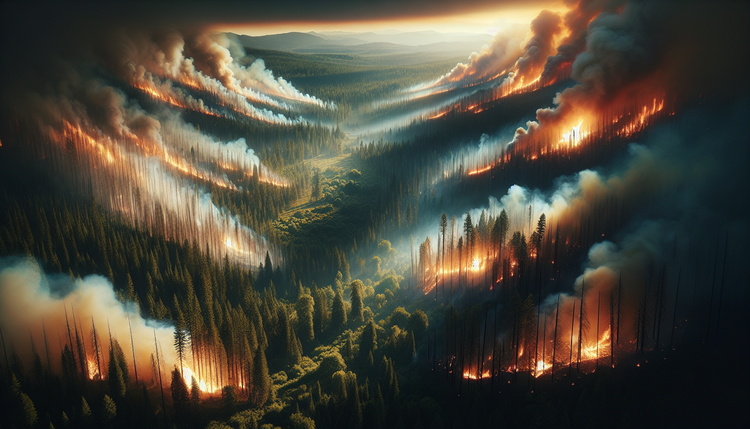
Overview
A wildfire is an unplanned, uncontrolled fire that burns in vegetation such as forests, grasslands, and shrublands. While many ecosystems evolved with fire and even depend on it, large, fast-moving wildfires can devastate communities, economies, and habitats. One of the most consequential in U.S. history began in Oregon’s Coast Range in 1933—the first fire of the Tillamook Burn.
This article explains how that blaze started, why it grew so rapidly, and what it taught us about wildfire behavior, forest management, and resilience—lessons that remain urgent in a warming world.
The first Tillamook Burn wildfire (1933)
In mid-August 1933, amid hot, dry weather, a logging operation in the Northern Oregon Coast Range accidentally sparked a fire. What began as a local incident quickly turned into a regional disaster. Driven by abundant fuels and wind, the blaze raced through rugged terrain, ultimately scorching 240,000 acres (970 km²) of forest. It was not fully extinguished until September 5, 1933, and the event became known as the first, defining wildfire of the Tillamook Burn.
Where and when
- Location: Northern Oregon Coast Range, near Tillamook County, in what is today the Tillamook State Forest.
- Ignition: A logging operation (human-caused) sparked the initial fire during a period of heat and drought.
- Timeline highlights: The fire ignited in August, experienced explosive growth later that month under strong winds, and was officially brought under control and declared fully extinguished by September 5.
Why it spread so fast
Three elements drive wildfire behavior—fuel, weather, and topography. In 1933, they aligned in ways that favored extreme fire behavior:
- Fuel: The Coast Range’s dense stands of old-growth Douglas-fir and hemlock, combined with logging slash (piles of branches and debris), provided abundant, dry material.
- Weather: Late-summer heat, low humidity, and wind set the stage for rapid spread and intense fire intensity.
- Topography: Steep slopes and narrow drainages funneled wind and preheated fuels upslope, allowing flames to climb hillsides quickly.
The result was a fire that crowned through canopies, generated tremendous heat, and created its own wind, making it extremely difficult to control with the tools and techniques available at the time.
What is a wildfire?
A wildfire (also called a forest fire, brush fire, bushfire, wildland fire, or vegetation fire) is any unplanned, uncontrolled fire in vegetated landscapes. Wildfires can start from natural causes like lightning or volcanic activity, as well as human causes, including equipment sparks, campfires, arson, and power lines.
Common types and terms
- Forest fire: Burns in forested landscapes with trees as the main fuel.
- Grass or brush fire: Burns in grasses and shrubs; can spread very quickly in wind.
- Peat or ground fire: Burns in organic soil layers, often smoldering for extended periods.
- Controlled burn (prescribed fire): A planned, intentionally set fire used by land managers to reduce hazardous fuels and restore ecological processes.
Fossil charcoal shows wildfires have occurred since terrestrial plants evolved, about 420 million years ago. Many species, from serotinous conifers to fire-following wildflowers, depend on periodic fire to regenerate. However, when fire occurs at unusual frequencies or intensities—especially where invasive plants or unusual fuel loads are present—it can be ecologically damaging and dangerous to people.
The Tillamook Burn series (1933–1951)
Although the 1933 blaze was the first and most infamous, it was not the last. Over the next two decades, three additional wildfires—occurring in 1939, 1945, and 1951—swept through much of the same area. Together, these events are remembered as the Tillamook Burn, a series that ultimately destroyed about 350,000 acres (140,000 hectares) of old-growth timber in the Northern Oregon Coast Range.
Why multiple fires?
- Reburn potential: After a severe fire, landscapes can be vulnerable. Dead standing trees and downed logs create heavy fuel loads. In dry, windy conditions, these fuels can feed new fires.
- Suppression legacy: Aggressive wildfire suppression, combined with the decline of Indigenous cultural burning practices in the region, allowed fuels to accumulate. While suppression protects communities in the short term, across large regions it can contribute to more severe fires later.
- Climate variability: Cycles of wet years that grow fuels followed by dry, hot periods heighten risk—patterns that climate change is intensifying in many places today.
Immediate impacts
- Timber and economy: The fires devastated valuable timberlands, disrupting logging operations and local economies dependent on the forest.
- Smoke and public health: Smoke reduced visibility and affected air quality across western Oregon. While contemporary air-quality monitoring didn’t exist as it does today, accounts describe thick, lingering smoke during peak burning periods.
- Communities and infrastructure: Towns near the burn scar faced repeated threats, road closures, and emergency responses. Fire camps swelled to thousands of firefighters.
Ecological effects
High-severity wildfire replaced old growth with “snag forest” habitat—standing dead trees, downed wood, and open, sunlit ground. This early seral habitat, while stark at first, supports rich biodiversity, including cavity-nesting birds, woodpeckers, and a flush of fire-following plants. Over time, forest succession begins again, with shrubs and young conifers taking root.
Yet the combination of repeated reburns and heavy fuel loads delayed recovery, making reforestation a central priority for Oregon in the mid-20th century.
From ashes to the Tillamook State Forest
In the aftermath, Oregon launched one of the largest reforestation efforts in U.S. history. Salvage logging removed some dead timber, and extensive planting programs followed. Schoolchildren, civic groups, and professional crews planted tens of millions of seedlings—primarily Douglas-fir—across the burn scar. By the early 1970s, roughly 72 million trees had been planted, laying the foundation for what we now know as the Tillamook State Forest.
Today, the area is a patchwork of recovering stands, managed forests, salmon-bearing streams, and recreation sites. Trails, scenic byways, and interpretation centers tell the story of the burn and its lessons for modern forest stewardship.
How wildfire behavior works
To understand why the 1933 fire was so extreme—and how to manage future wildfire risk—consider the “fire behavior triangle” of fuel, weather, and topography:
- Fuel: Type, amount, and arrangement of vegetation. Fine, dry fuels ignite easily; heavy, continuous fuels sustain big flames and can produce crown fires.
- Weather: Heat, humidity, wind, and atmospheric stability all influence spread and intensity.
- Topography: Fire moves faster uphill. Canyons and ridges can channel wind and embers.
Severe wildfires commonly follow a pattern: wet years build vegetation, then drought and heat set the stage for ignition and rapid spread—especially when wind arrives. Climate change increases the odds of hot, dry, and windy conditions, lengthening fire seasons and contributing to larger burns.
Wildfires: costs, benefits, and smarter management
Wildfires can be both destructive and ecologically necessary. The key is keeping fire within a range of behavior that ecosystems and communities can tolerate. A modern, ecological approach includes:
- Prescribed fire: Carefully planned, controlled burns reduce hazardous fuels and restore natural fire cycles.
- Mechanical thinning: Removing dense understory where appropriate can lower fire intensity near communities.
- Cultural burning: Restoring Indigenous fire stewardship recognizes centuries of knowledge about using low-intensity fire to maintain healthy landscapes.
- Home hardening and defensible space: Fire-resistant roofs and vents, ember-resistant screens, and vegetation management around homes reduce risk in the wildland–urban interface (WUI).
- Strategic suppression: Firefighting remains essential to protect lives and infrastructure, complemented by prevention and mitigation to avoid catastrophic events.
Prevention and preparedness in fire-prone regions
- Prevent ignitions: Secure chains and equipment that might spark; observe burn bans; fully extinguish campfires.
- Prepare properties: Maintain defensible space, clear gutters, choose fire-resistant materials, and store firewood away from structures.
- Plan ahead: Know evacuation routes, assemble go-kits, and sign up for local alerts during fire season.
Quick facts: the first Tillamook Burn wildfire
- Event: First wildfire of the Tillamook Burn series
- Cause: Human-caused, sparked by logging operations
- Location: Northern Oregon Coast Range, United States
- Area burned in 1933: 240,000 acres (970 km²)
- Control date: Declared fully extinguished on September 5, 1933
- Total series impact (1933–1951): Approximately 350,000 acres (140,000 hectares) of old-growth timber destroyed across multiple fires
- Legacy: Massive reforestation effort led to the creation and restoration of the Tillamook State Forest
Why the Tillamook Burn still matters
The Tillamook Burn is more than a historical footnote. It illustrates how ignition sources, fuel buildup, and weather can combine to make extreme fire—and how communities can respond with science, stewardship, and long-term investment. As climate change intensifies heat and drought in many regions, the lessons of 1933 resonate: prevent avoidable ignitions, manage fuels proactively, and plan for fire as an ecological force that must be lived with, not simply fought against.
FAQ
What started the first Tillamook Burn wildfire?
A logging operation in Oregon’s Coast Range accidentally sparked the blaze in August 1933. Dry fuels, heat, and wind helped it spread rapidly.
How big was the 1933 fire?
It burned approximately 240,000 acres (970 km²) before it was fully extinguished on September 5, 1933.
Why is it called the Tillamook Burn?
The name refers both to the initial 1933 wildfire and to the series of four major fires (1933, 1939, 1945, 1951) that repeatedly burned much of the same Northern Oregon Coast Range landscape near Tillamook.
Did the area ever recover?
Yes. A landmark reforestation program—planting tens of millions of trees—helped restore the landscape. The area is now the Tillamook State Forest, a mix of managed timberlands, wildlife habitat, and recreation.
Are wildfires always bad for forests?
No. Many forests evolved with periodic fire, which can reduce fuel loads, recycle nutrients, and open habitat. Problems arise when fires burn with unusually high severity or in areas unadapted to fire, often due to fuel accumulation, invasive species, or extreme weather.
What is the difference between a controlled burn and a wildfire?
A controlled (prescribed) burn is intentionally set under specific weather and fuel conditions to meet ecological or risk-reduction goals. A wildfire is unplanned and uncontrolled, posing greater danger to people and property.
How is climate change influencing wildfires today?
Warming temperatures and longer dry periods increase fuel aridity and lengthen fire seasons, contributing to more frequent and larger wildfires. This is especially evident in regions with Mediterranean climates and boreal forests.