
 English
  español
  français
  português
  русский
  العربية
  简体中文
简体中文 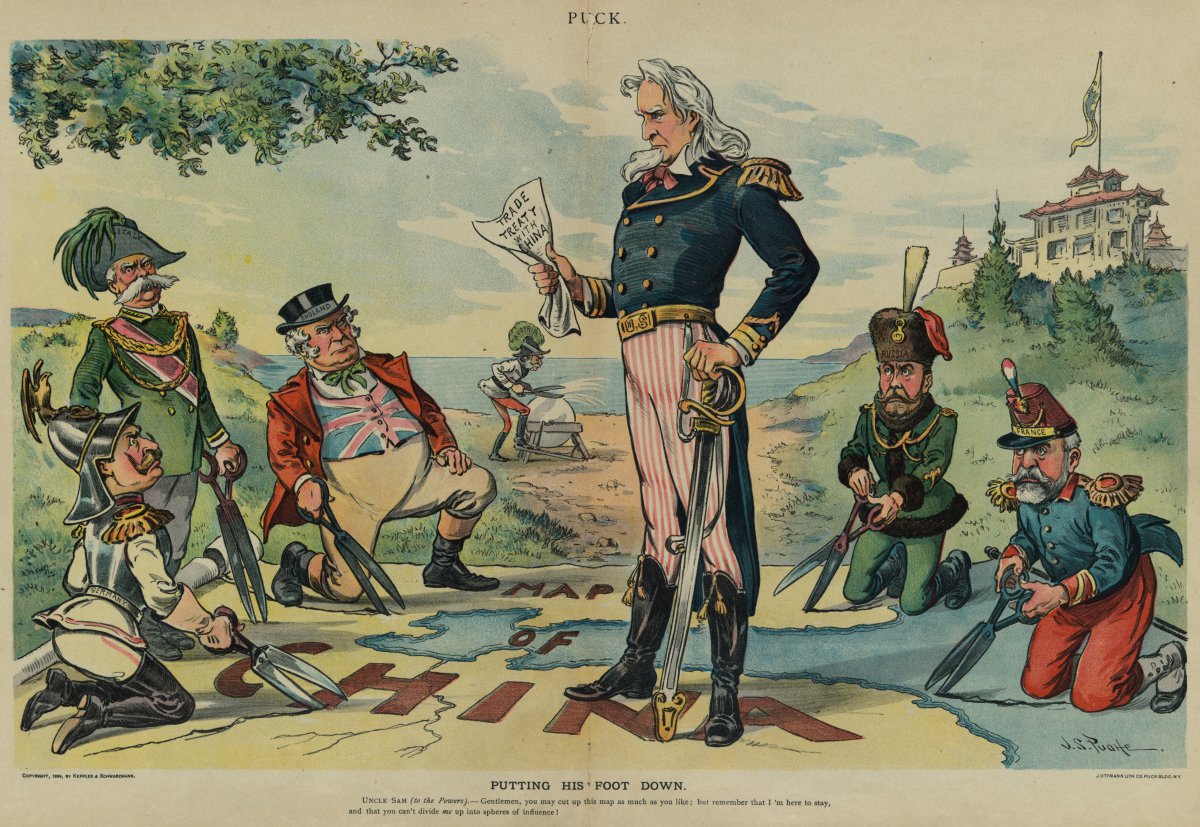
John Milton Hay (October 8, 1838 – July 1, 1905) was a prominent American statesman, diplomat, and author whose distinguished career in government spanned nearly five decades, from the tumultuous era of the American Civil War into the nascent 20th century. His journey began in intimate proximity to power, serving as a private secretary and assistant to President Abraham Lincoln during one of the most pivotal periods in U.S. history. Hay's remarkable trajectory culminated in holding the esteemed office of United States Secretary of State under two successive presidents, William McKinley and Theodore Roosevelt, where he played a crucial role in shaping American foreign policy. Beyond his governmental roles, Hay was also an accomplished literary figure, dedicating much of his life to writing poetry, biographies, and other forms of literature.
Born into an anti-slavery family in Indiana, Hay's family relocated to Warsaw, Illinois, during his youth. His evident intellectual promise led his family to send him to Brown University, a distinguished institution, from which he graduated in 1858. Following his graduation, Hay pursued legal studies, reading law in his uncle's office in Springfield, Illinois. This office was notably adjacent to that of Abraham Lincoln, a proximity that proved instrumental in shaping Hay's future. He quickly became involved in Lincoln's successful 1860 presidential campaign, subsequently earning a coveted position as one of Lincoln's private secretaries at the White House. During the entirety of the American Civil War, Hay remained an exceptionally close confidant to President Lincoln, offering a unique, firsthand perspective on the presidency during wartime. His loyalty and devotion were evident as he stood vigil by Lincoln's deathbed following the President's tragic assassination at Ford's Theatre. Among his significant literary contributions, Hay, in collaboration with John George Nicolay, co-authored a monumental multi-volume biography of Abraham Lincoln. This seminal work not only chronicled the life of the 16th President but also profoundly influenced and helped to solidify Lincoln's enduring historical image and legacy for future generations.
Ascension to Secretary of State and Diplomatic Milestones
Following the profound tragedy of Lincoln's assassination, John Hay embarked on a new phase of his career, gaining invaluable international experience through several diplomatic appointments in Europe. These assignments broadened his understanding of global affairs and prepared him for future high-level positions. Upon his return to the United States, Hay transitioned briefly into journalism, working for the influential New-York Tribune under the distinguished editorship of Horace Greeley and later Whitelaw Reid, honing his communication and analytical skills. Remaining deeply engaged in the political sphere, Hay's public service resumed when he served as Assistant Secretary of State from 1879 to 1881, offering him insights into the workings of the State Department. After a period in the private sector, his political influence and strategic alliances paid dividends when President William McKinley, a key beneficiary of Hay's significant political backing, appointed him Ambassador to the United Kingdom in 1897. This prestigious role further elevated his diplomatic standing. The following year, in 1898, Hay's exemplary service and capabilities were recognized with his appointment as United States Secretary of State, the pinnacle of his governmental career.
Hay's tenure as Secretary of State, spanning nearly seven years first under President McKinley and then, following McKinley's tragic assassination, under President Theodore Roosevelt, was marked by pivotal diplomatic achievements that reshaped American foreign policy and asserted the United States' growing influence on the global stage. He is most famously associated with the articulation and implementation of the Open Door Policy, a critical diplomatic initiative designed to ensure equal commercial opportunities in China for all international powers and to safeguard China's territorial integrity amidst intense imperialistic competition. Furthermore, Hay's tireless efforts were instrumental in facilitating the construction of the Panama Canal, a monumental engineering and strategic undertaking. His diplomatic skill was evident in the negotiation of a series of treaties:
The Hay–Pauncefote Treaty with the United Kingdom (1901): This agreement superseded the earlier Clayton-Bulwer Treaty of 1850, which had stipulated joint Anglo-American control over any Central American canal. The Hay–Pauncefote Treaty granted the United States the sole right to construct, manage, and fortify a canal across the Isthmus of Panama, unequivocally clearing the diplomatic path for American unilateral action.
The Hay–Herrán Treaty with Colombia (1903): This treaty sought to secure a lease from Colombia for a canal zone. Although negotiated successfully by Hay, it was ultimately rejected by the Colombian Senate, which found the terms unfavorable and an infringement on national sovereignty. This rejection subsequently led to a significant diplomatic impasse.
The Hay–Bunau-Varilla Treaty with the newly independent Republic of Panama (1903): Following Panama's declaration of independence from Colombia, which was swiftly recognized by the United States, this treaty was quickly negotiated. It granted the U.S. a perpetual lease on a 10-mile wide strip of land across the Isthmus for the construction of the canal, solidifying the legal framework for this vital waterway. This treaty, though highly beneficial to the U.S., remains controversial due to the circumstances surrounding Panama's independence.
Through these diplomatic triumphs, John Hay not only secured America's commercial interests but also solidified its position as a burgeoning world power, capable of undertaking ambitious geopolitical projects.
The Open Door Policy: Context, Aims, and Legacy
The Open Door Policy represents a cornerstone of United States diplomatic engagement in East Asia during the late 19th and early 20th centuries. Articulated by U.S. Secretary of State John Hay, this policy called for a system of equal commercial opportunity for all nations trading with Qing China, alongside a fundamental commitment to guaranteeing China's territorial and administrative integrity. It emerged during a period of intense imperialistic competition among global powers, often referred to as the "Scramble for Concessions," where European nations and Japan were actively establishing "spheres of influence" within China, threatening to dismember the ailing Qing Dynasty much like parts of Africa had been partitioned by colonial powers.
Secretary Hay formally enunciated this policy in his initial "Open Door Note," dispatched on September 6, 1899, to the major European powers with vested interests in China – specifically Great Britain, Germany, France, Italy, Russia, and Japan. The primary objective of this diplomatic communication was to prevent the outright "carving of China like a melon" into exclusive colonial possessions. The Note urged these powers to:
Maintain open access to all treaty ports within their respective spheres of influence.
Allow Chinese authorities to collect customs tariffs uniformly and on an equal basis for all nations.
Refrain from granting preferential treatment to their own nationals regarding railroad charges or harbor dues within their spheres.
Despite its clear articulation, the Open Door Policy was met with cautious and often reluctant acceptance from the major powers, who generally offered only qualified agreements or avoided direct commitment. Critically, the policy lacked a formal legal standing in international law and possessed no explicit enforcement mechanism, relying instead on the perceived moral authority of the United States and the balance of power among the interested nations. The policy's principles were put to the test during the violent anti-foreign Boxer Uprising of 1900. As international forces contemplated military intervention to suppress the rebellion, Secretary Hay strategically issued a Second Open Door Note in July 1900. This second note reaffirmed the U.S. commitment to China's territorial integrity and administrative entity, broadening the policy's scope beyond mere commercial equality to include political sovereignty.
Over the subsequent decades, American policymakers and national leaders consistently invoked the Open Door Policy as a foundational doctrine of U.S. foreign policy in Asia, particularly regarding China. Chinese diplomats, seeking to leverage external support against encroaching foreign influence, frequently appealed to the policy's principles. However, many critics throughout history have pointed out that while the Open Door Policy served as an important moral and diplomatic statement, its practical effect in truly curbing imperialistic ambitions or fundamentally altering the trajectory of Chinese sovereignty was often limited, especially in the absence of a strong U.S. military presence in the region to enforce its tenets.
The Enduring Concept of the "Open Door"
The term "Open Door" has evolved beyond its original diplomatic context concerning 19th-century China to describe broader concepts in international relations and economics. Notably, it characterizes the transformative economic policy launched by Deng Xiaoping in 1978. This landmark initiative, often referred to as "Reform and Opening Up" (Gǎigé Kāifàng), systematically opened China to foreign investment, technology, and market forces after decades of relative isolation under Mao Zedong's leadership. This policy involved establishing Special Economic Zones (SEZs), attracting foreign direct investment, and gradually integrating China into the global economy, thereby initiating the unparalleled economic transformation that has defined modern China.
Furthermore, in contemporary academic discourse, particularly within the field of international relations, scholars like Christopher Layne, associated with the neorealist school of thought, have generalized the application of the "Open Door" concept. They use it to analyze and describe the "political" and "economic" open door policies adopted by nations in general when interacting on a global or international basis. This expanded usage refers to a state's strategic decision to open its borders or markets to external influences, be it for trade, investment, cultural exchange, or political engagement, often with the aim of maximizing its own power or prosperity within the international system.
- Frequently Asked Questions (FAQs) about John Milton Hay and the Open Door Policy
- Who was John Milton Hay?
John Milton Hay was a prominent American statesman, diplomat, author, and private secretary to President Abraham Lincoln, who later served as the United States Secretary of State under Presidents William McKinley and Theodore Roosevelt from 1898 to 1905.
- What was John Hay's connection to Abraham Lincoln?
Hay began his career as one of Abraham Lincoln's private secretaries at the White House during the American Civil War, developing a close relationship with the President. He was present at Lincoln's deathbed and later co-authored a definitive multi-volume biography of Lincoln.
- What was the Open Door Policy?
The Open Door Policy was a U.S. diplomatic initiative proposed by Secretary of State John Hay in 1899 and 1900. It aimed to ensure equal trading opportunities for all nations in China and to preserve China's territorial and administrative integrity amidst increasing imperialistic ambitions by other global powers.
- How did John Hay contribute to the Panama Canal?
John Hay was instrumental in securing the diplomatic framework for the construction of the Panama Canal. He negotiated three key treaties: the Hay–Pauncefote Treaty with the UK, which granted the U.S. sole rights to build the canal; the unratified Hay–Herrán Treaty with Colombia; and finally, the Hay–Bunau-Varilla Treaty with the newly independent Republic of Panama, which granted the U.S. perpetual lease of the Canal Zone.
- Is the Open Door Policy relevant today?
While the original Open Door Policy pertains specifically to late 19th and early 20th-century China, the term has been generalized by scholars to describe broader "open door" economic and political policies adopted by nations in the 20th and 21st centuries to engage with the global economy and international relations. Additionally, China's "Reform and Opening Up" policy initiated by Deng Xiaoping in 1978 is also commonly referred to as an "Open Door" policy.