
 English
  español
  français
  português
  русский
  العربية
  简体中文
简体中文 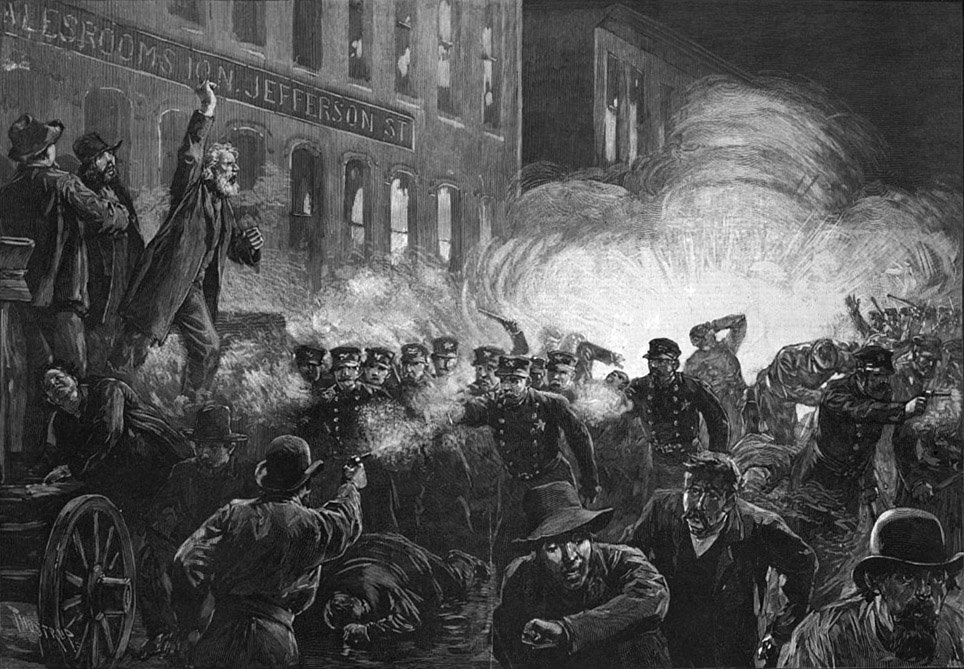
The Haymarket affair, an event etched into the annals of American labor history, is known by several names: the Haymarket massacre, the Haymarket riot, the Haymarket Square riot, or simply the Haymarket Incident. This pivotal moment on May 4, 1886, at Chicago's Haymarket Square in Illinois, United States, unfolded as the grim aftermath of a bombing during a labor demonstration. What began as a hopeful, peaceful assembly in solidarity with workers striking for an eight-hour workday quickly descended into chaos and tragedy, leaving an indelible mark on the global labor movement and American society.
The Seeds of Discontent: The Eight-Hour Movement and the Great Upheaval
To fully grasp the gravity of the Haymarket affair, one must understand the tumultuous backdrop of late 19th-century America. Industrialization had dramatically transformed the nation, but often at the expense of the working class. Long hours, low wages, and perilous conditions fueled widespread discontent across various industries. The demand for an eight-hour workday—a stark contrast to the typical ten or even twelve-hour shifts that often left workers exhausted and exploited—had become a powerful rallying cry, symbolizing a yearning for dignity, improved health, and a better quality of life. This intense period of social unrest among workers, marked by widespread strikes, protests, and calls for reform across the country, is historically known as the Great Upheaval. Tensions in Chicago, a bustling industrial hub, had already escalated just a day before the Haymarket rally, when police opened fire on striking workers at the McCormick Harvesting Machine Company, killing one and injuring several others. This incident served as the immediate, volatile catalyst for the May 4th gathering, intensifying the resolve of labor advocates and anarchists to demonstrate for their rights and to protest police brutality.
A Fateful Evening in Haymarket Square
On the evening of May 4, 1886, despite a light rain, an estimated crowd of several thousand people gathered peacefully at Haymarket Square. The purpose was clear: to protest the recent police violence at McCormick and to continue advocating for the establishment of an eight-hour workday. A succession of speakers, predominantly anarchists and labor radicals who were prominent figures in Chicago's vibrant labor scene, addressed the assembly. Their speeches, while passionate and often critical of industrial capitalism and government authority, maintained a largely orderly atmosphere. As the evening progressed and the crowd began to thin, with the final speaker on the platform, police forces numbering around 180 officers marched into the square. Led by Captain John Bonfield, they ordered the remaining demonstrators to disperse, declaring the meeting unlawful. It was at this critical and highly tense juncture, as the meeting was being broken up, that an unidentified individual hurled a dynamite bomb into the ranks of the police officers, triggering an immediate and devastating escalation of events.
The Aftermath: Bomb Blast and Chaos
The explosion was deafening, tearing through the quiet night and shattering the fragile peace of the square. Amidst the sudden chaos and confusion, police immediately opened fire, and in the ensuing fusillade, both officers and civilians were caught in a terrifying crossfire. When the smoke and confusion cleared, the toll was horrific: seven police officers and at least four civilians lay dead or dying, with dozens more wounded. The exact number of civilian casualties is often debated by historians, but it is unequivocally clear that Haymarket Square became a scene of profound violence and loss. This single, devastating act of terror and the subsequent, often indiscriminate, police response forever altered the trajectory of the American labor movement, deeply polarizing public opinion, and igniting a fierce national debate about justice, civil liberties, and the rights of workers to organize and protest.
The Highly Controversial Trial and its Verdicts
In the wake of the bombing, public outcry was immense and immediate, fueled by sensationalist newspaper reports that demonized labor radicals, particularly anarchists, as dangerous enemies of society bent on overthrowing the social order. Despite the profound uncertainty surrounding who exactly threw the bomb, authorities swiftly rounded up and charged eight prominent anarchists with conspiracy to commit murder. The legal proceedings that followed, from January to August 1887, captivated national and international attention, becoming infamous for their perceived biases and the glaring lack of direct evidence linking the defendants to the physical act of throwing the bomb. While evidence presented suggested that one of the defendants might have manufactured the explosive device, there was no concrete proof that any of the accused had actually thrown it. The prosecution, instead, argued that by their inflammatory speeches, writings, and organizational activities, the anarchists had incited the unknown bomb-thrower, making them equally culpable under the then-novel legal theory of conspiracy. All eight defendants were ultimately convicted, a verdict that many observers at the time, and a vast majority of historians since, have criticized as a severe miscarriage of justice, driven more by anti-radical fervor and a desire for retribution than by concrete legal proof.
Executions, Commutations, and a Historic Pardon
The sentences handed down were severe and uncompromising: seven of the convicted anarchists were condemned to death by hanging, while one received a 15-year prison term. The appeals process was exhausting and protracted, but ultimately unsuccessful in overturning the convictions. In a significant intervention, Illinois Governor Richard J. Oglesby commuted the sentences of two of the condemned, Samuel Fielden and Michael Schwab, to life imprisonment, citing doubts about their direct involvement. Another defendant, Louis Lingg, tragically took his own life in jail, reportedly by detonating a small bomb in his mouth, just hours before he was scheduled to face the gallows, choosing death on his own terms over state execution. On November 11, 1887, a date forever remembered as Black Friday by labor activists, the remaining four—August Spies, Albert Parsons, Adolph Fischer, and George Engel—were hanged. Years later, in 1893, a new Illinois Governor, John Peter Altgeld, took the courageous and politically controversial step of pardoning the three remaining imprisoned defendants (Fielden, Schwab, and Oscar Neebe, who had received the 15-year sentence). Governor Altgeld issued a scathing, detailed critique of the original trial, arguing vehemently that the jury was packed and prejudiced, the judge biased, and the evidence insufficient to prove guilt beyond a reasonable doubt, effectively vindicating the men who had been condemned. His actions, while widely praised by labor and civil liberties advocates, earned him considerable political backlash and likely cost him his political career.
The Enduring Legacy: May Day and a Turning Point in Labor History
The Haymarket affair, despite its tragic outcome and immediate chilling effect on some labor organizing, profoundly influenced the trajectory of the labor movement, both domestically and internationally. It is widely regarded as the principal catalyst for the establishment of International Workers' Day, celebrated globally on May 1st. This date, distinct from the U.S. Labor Day (which was strategically moved to September by President Grover Cleveland to disassociate it from the radical connotations of May 1st), serves as a powerful and enduring reminder of the Haymarket martyrs and the ongoing worldwide struggle for workers' rights and social justice. The event also marked the climax of the aforementioned Great Upheaval, serving as a stark illustration of the intense social and economic tensions gripping late 19th-century America. As labor historian William J. Adelman eloquently put it, "No single event has influenced the history of labor in Illinois, the United States, and even the world, more than the Chicago Haymarket Affair. It began with a rally on May 4, 1886, but the consequences are still being felt today. Although the rally is included in American history textbooks, very few present the event accurately or point out its significance." The incident undoubtedly set back the immediate push for the eight-hour day in some sectors but simultaneously galvanized a more unified and determined labor movement in the long run, forcing a national conversation about industrial justice and the treatment of the working class.
Honoring the Memory: Landmarks and Monuments
Today, the Haymarket affair remains an important subject of study and commemoration, its memory preserved in key historical markers. The original site of the incident at Haymarket Square, a place of profound historical significance, was officially designated a Chicago landmark in 1992, ensuring its place in the city's historical narrative. A thought-provoking sculpture, titled "Haymarket Martyrs' Monument" (though distinct from the burial monument), serving as a poignant tribute to the event and its victims, was dedicated there in 2004, designed by artist Mary Brogger. Furthermore, the actual Haymarket Martyrs' Monument, designed by Albert Weinert and located at the defendants' burial site in Forest Home Cemetery, Forest Park, Illinois, received national recognition in 1997 when it was designated a National Historic Landmark. These memorials stand as enduring testaments to the complex legacy of the Haymarket affair, a stark and vital reminder of the sacrifices made in the pursuit of workers' rights, social justice, and the ongoing struggle for a more equitable society.
Frequently Asked Questions (FAQs)
- What was the primary cause of the Haymarket affair?
- The Haymarket affair stemmed from the broader struggle for an eight-hour workday and the intense social unrest known as the Great Upheaval in late 19th-century America. The immediate catalyst for the May 4th rally was a protest against police violence at the McCormick Harvesting Machine Company a day earlier, where police had fired on striking workers.
- Who threw the bomb at Haymarket Square?
- The individual who threw the dynamite bomb at the police remains unknown to this day. This enduring mystery was a central and highly controversial aspect of the subsequent trials, as no direct evidence ever identified the actual perpetrator.
- Were the Haymarket anarchists truly guilty of the bombing?
- The conviction of the eight anarchists for conspiracy was highly controversial and widely debated. While evidence suggested one defendant may have built the bomb, there was no direct evidence that any of the accused had thrown it. Their conviction was largely based on their speeches and writings, which prosecutors argued had incited the unknown bomb-thrower, leading many contemporary observers and later historians to view the trial as a politically motivated miscarriage of justice.
- What is the significance of the Haymarket affair for International Workers' Day?
- The Haymarket affair is widely considered the origin of International Workers' Day, or May Day, which is celebrated globally on May 1st. It serves as a commemoration of the Haymarket martyrs and a powerful symbol for the worldwide struggle for labor rights and social justice.
- What was the "Great Upheaval"?
- The Great Upheaval refers to a period of intense and widespread labor unrest, strikes, and social agitation across the United States in the 1880s. Workers were protesting against long hours, low wages, and dangerous working conditions, primarily advocating for the establishment of an eight-hour workday.