
 English
  español
  français
  português
  русский
  العربية
  简体中文
简体中文 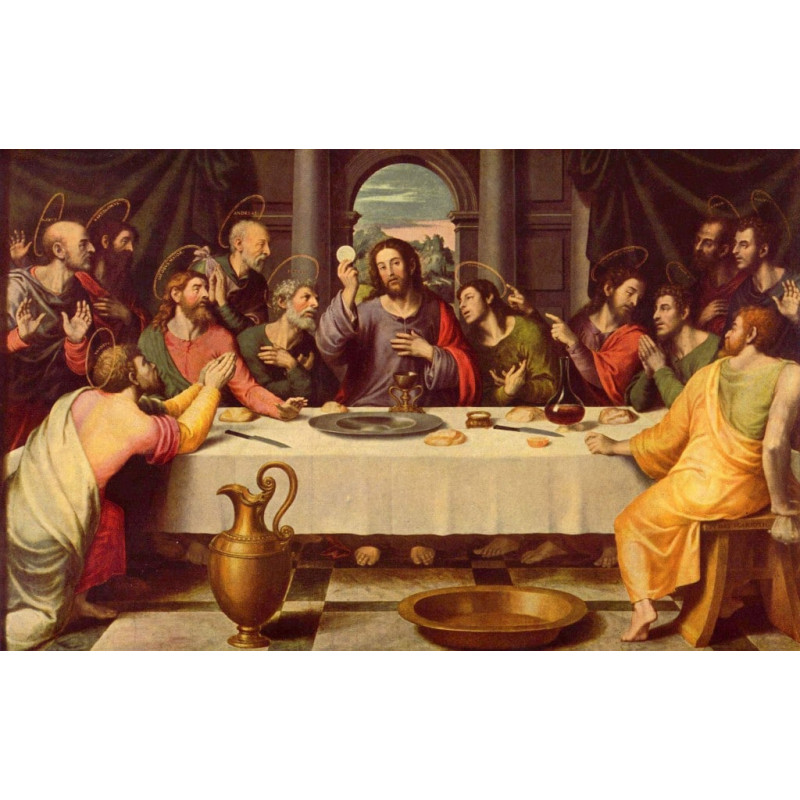
Holy Thursday, also reverently known as Maundy Thursday, stands as a profoundly significant Christian holy day, observed on the Thursday immediately preceding Easter Sunday. This sacred day serves as a poignant commemoration of pivotal events in the final hours of Jesus Christ's earthly ministry: the Last Supper shared with His Apostles and the humble act of foot washing, known as the Mandatum. As the fifth day of the solemn Holy Week, it follows Holy Wednesday and sets the stage for the somber observances of Good Friday, marking the solemn approach to the Paschal Mystery.
The Last Supper is foundational to Christian faith, as it was during this meal that Jesus instituted the Eucharist, or Holy Communion, inviting His disciples to partake in His body and blood under the species of bread and wine. This act established a new covenant and remains the central sacrament of Christian worship. Furthermore, the canonical gospels, particularly the Gospel of John (Chapter 13), vividly describe Jesus’ extraordinary act of humility: washing the feet of His disciples. This selfless service was not merely a symbolic gesture but a profound lesson in servant leadership and unconditional love, instructing His followers to emulate His example of selfless devotion.
Understanding "Maundy": A Commandment of Love
The term "Maundy" in Maundy Thursday is primarily derived from the Latin word "mandatum," meaning "commandment." This etymology directly references Jesus' words to His disciples during the Last Supper, following the foot washing, as recorded in John 13:34-35: "A new commandment I give to you, that you love one another: just as I have loved you, you also are to love one another. By this all people will know that you are my disciples, if you have love for one another." This "new commandment" to love with a sacrificial and humble heart underpins the spiritual significance of the day's traditions. While some less common linguistic theories have linked "Maundy" to Old Norse "munu" (shall or will) or Old English "gemynd" (the mind), the prevailing and most spiritually resonant origin is undeniably from the Latin "mandatum," highlighting the essence of Christ's teaching.
Divergent Calendars, Shared Commemoration
The observance of Holy Thursday, like Easter itself, sees variations in its date across different Christian traditions due to the use of distinct ecclesiastical calendars. The majority of Western Christian denominations, including Roman Catholics, Protestants, and many Anglicans, adhere to the Gregorian calendar, the most widely adopted civil calendar globally. Consequently, their Holy Thursday generally falls between March 19th and April 22nd. Conversely, many Eastern Churches, particularly the Eastern Orthodox Churches, predominantly utilize the older Julian calendar for their liturgical calculations.
This difference in calendar systems means that while the core theological principles for determining Easter (and thus Holy Thursday) remain similar – typically the first Sunday after the first full moon on or after the vernal equinox – the actual date on a Gregorian calendar can differ significantly. For instance, throughout the 21st century, the Julian calendar might place Holy Thursday on what corresponds to April 1st in some years or even May 5th in others, according to the Gregorian calendar. This divergence underscores the rich diversity within global Christianity while maintaining a unified commemoration of Christ's Paschal Mystery.
Initiating the Sacred Easter Triduum
The evening liturgy of Maundy Thursday, often referred to as the Mass of the Lord's Supper or the Divine Liturgy, holds paramount importance as it formally initiates the Easter Triduum. This sacred period, spanning from Holy Thursday evening through Good Friday and Holy Saturday, culminates on the evening of Easter Sunday. It is considered a single, continuous liturgical celebration that traces the deepest mysteries of Christian faith: the Passion, Death, and Resurrection of Jesus Christ.
The timing of the Mass of the Lord's Supper in the evening is deeply rooted in Jewish tradition, where a new day begins at sunset. This aligns perfectly with the historical context of the Last Supper itself, which, according to the three Synoptic Gospels (Matthew, Mark, and Luke), was observed as a Passover Seder meal. The Jewish Feast of Passover commemorates the liberation of the Israelites from slavery in Egypt. By holding His final meal as a Passover Seder, Jesus imbued it with new meaning, transforming the ancient deliverance story into the ultimate act of salvation through His self-sacrifice. The Triduum thus begins with this foundational liturgy, leading the faithful on a profound spiritual journey through sorrow and anticipation to the joy of resurrection.
Common Questions About Holy ThursdayWhat is Holy Thursday?Holy Thursday, also known as Maundy Thursday, is a Christian holy day celebrated on the Thursday before Easter. It commemorates the Last Supper of Jesus Christ with His Apostles and His act of washing their feet.
Why is it also called Maundy Thursday?The name "Maundy" comes from the Latin word "mandatum," meaning "commandment." This refers to Jesus' "new commandment" given during the Last Supper: "A new commandment I give to you, that you love one another: just as I have loved you, you also are to love one another" (John 13:34).
What important events does Holy Thursday commemorate?It primarily commemorates the institution of the Eucharist (Holy Communion) at the Last Supper and Jesus' humble act of washing His disciples' feet, symbolizing selfless service and love.
Why do the dates for Holy Thursday vary between Christian traditions?The variation in dates is due to different Christian denominations using different calendars for their liturgical calculations. Western churches predominantly use the Gregorian calendar, while many Eastern Orthodox Churches use the Julian calendar, leading to different Easter and Holy Thursday dates.
What is the significance of the Easter Triduum?The Easter Triduum is a single, continuous liturgical period that begins on Holy Thursday evening and concludes on Easter Sunday evening. It commemorates the entire Paschal Mystery: the Passion, Death, and Resurrection of Jesus Christ, serving as the climax of the Christian liturgical year.