
 English
  español
  français
  português
  русский
  العربية
  简体中文
简体中文 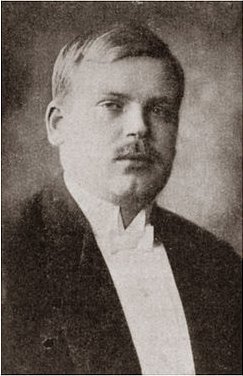
Jüri Vilms, a name synonymous with Estonia's fervent struggle for independence, stands as a pivotal figure in the nation's early 20th-century history. Born into a time of great upheaval, his life was tragically cut short, but not before he made indelible contributions to the dream of a sovereign Estonia. As a brilliant legal mind, a passionate politician, and a courageous patriot, Vilms played a central role in laying the groundwork for the independent Estonian state, including his crucial part in the historic Declaration of Independence in 1918. His story is one of intellect, dedication, and ultimate sacrifice, a testament to the Estonian spirit against overwhelming odds.
Early Life and Education
Jüri Vilms entered the world on March 13, 1889, in Arkma, a quiet corner of what was then Kabala Parish in Kreis Fellin, Governorate of Livonia – an area now known as Türi Parish in Järva County. From an early age, Vilms displayed remarkable academic prowess. His intellect shone brightly during his time at Pärnu Gymnasium, where his exceptional grades not only earned him a place but also qualified him for free tuition, a testament to his dedication and potential. This early success paved the way for higher education, leading him to the esteemed University of Tartu. From 1907 to 1911, he immersed himself in the study of law within the university’s Faculty of Law, further honing his sharp mind. During these formative years, Vilms also became an active member of the Estonian Students Association, a vibrant hub of intellectual and nationalistic thought, where his leadership qualities were recognized by his peers, who elected him chairman.
A Rising Legal and Political Star
Upon graduating from the University of Tartu in 1911, Jüri Vilms wasted no time in embarking on his legal career. He began as an associate, diligently building his experience and reputation, before demonstrating his entrepreneurial spirit by establishing his own law firm. This period coincided with the dramatic onset of World War I, a conflict that irrevocably reshaped the geopolitical landscape and ignited a fierce sense of national identity across Europe. For Vilms, the war served as a catalyst, drawing him deeply into the burgeoning Estonian National Movement. He became a vocal proponent for Estonian autonomy, publishing articles that eloquently articulated the demand for self-governance within the vast Russian Empire, believing that the future of Estonia lay in its own hands, not those of a distant imperial power.
Shaping Estonia's Future: Political Ideologies and Party Founding
In the crucible of the Estonian National Movement, Jüri Vilms emerged as a clear and independent voice, unafraid to challenge established figures. He was a man of firm convictions, often criticizing the political concepts of his contemporaries. For instance, he found himself at odds with Jaan Tõnisson, who advocated primarily for cultural autonomy, believing it didn't go far enough to secure Estonia's future. Similarly, he critiqued Konstantin Päts's approach, which saw political opportunities in cooperating with the Baltic Germans in Estonia – a stance Vilms likely viewed as compromising true national self-determination. Driven by his vision for a truly independent and socially progressive Estonia, Vilms took a decisive step in 1917, founding a new political party: the Eesti Tööerakond, or Estonian Labour Party. This left-of-centre party was designed to represent the interests of working people and champion a path towards full political autonomy.
The Architect of Autonomy
The seismic events of the Russian February Revolution in 1917 transformed Jüri Vilms into a full-time politician, completely dedicated to the cause of his nation. His tireless efforts and clear vision earned him the profound moniker "advocate of the Estonian people" from Aleksander Looring, a testament to his popularity and perceived commitment. With remarkable foresight and legal acumen, Vilms, alongside fellow patriots Heinrich Koppel, Otto Strandman, and Jaan Raamot, meticulously compiled the legal preparations for the administrative reforms that would establish the Autonomous Governorate of Estonia. These meticulously crafted documents proved instrumental, forming the very basis for the decree issued by the Russian Provisional Government on March 30, 1917 (April 12, 1917, in the New Style calendar), which officially granted autonomy to Estonia. This was a monumental step, giving Estonia its first taste of self-rule and laying the essential administrative foundations for future independence.
The Road to Independence: The Salvation Committee and the Declaration
As 1918 dawned, the political situation in Estonia became even more precarious. The retreating Russian troops and the advancing German forces during World War I created a dangerous power vacuum, a fleeting window of opportunity that patriots like Jüri Vilms knew they had to seize. In this critical moment, the Estonian Salvation Committee, empowered by the democratically elected Maapäev (Estonian Provincial Assembly), took a bold and historic step. On February 24, 1918, amidst the chaos, they issued the Estonian Declaration of Independence, a beacon of hope for a nation yearning for freedom. As a distinguished member of this vital committee and the first Deputy Prime Minister of the newly proclaimed Republic of Estonia, Vilms stood at the very forefront of this audacious act. However, the jubilant cries of independence were short-lived; the German forces, upon taking over the country, refused to recognize Estonia’s sovereignty, forcing the Salvation Committee and its members underground.
A Dangerous Mission and a Mysterious Demise
With Estonia under German occupation and its independence unrecognized, the fledgling government faced an urgent need for international recognition and support. It was a perilous time, and Jüri Vilms, embodying the spirit of selfless sacrifice, volunteered for a critically dangerous mission. He bravely set out for Finland, tasked with taking essential funds and instructions to the Estonian missions operating abroad, whose crucial work involved securing diplomatic recognition for the newly declared sovereign nation. Tragically, Vilms never completed his mission. The precise circumstances of his demise remain a subject of historical debate, adding a layer of mystery to his heroic end. According to an "official" version that circulated for many years, he was captured upon reaching the Finnish coast and subsequently executed by German troops in Helsinki. However, more recent and diligent research suggests a different, equally grim fate: that Jüri Vilms may have been executed by a unit of the Swedish Brigade in Hauho, near Hämeenlinna, Finland. Regardless of the exact perpetrators or location, his death, on or around May 2, 1918, was a profound loss for the nascent Estonian state.
Legacy and Lasting Impact
Although Jüri Vilms did not live to see the full realization of his dreams, his sacrifice was not in vain. Estonia ultimately achieved its hard-won independence after the German Revolution led to the withdrawal of German troops from Estonian territory, followed by the successful Estonian War of Independence. This epic struggle culminated in the historic Peace Treaty of Tartu, which officially recognized Estonia's sovereignty. Vilms’s intellectual contributions, his legal work, his political activism, and his ultimate sacrifice were indispensable threads in the tapestry of Estonia's journey to statehood. His profound impact on Estonian history has even been immortalized in literature; the acclaimed Estonian author Jaan Kross vividly characterized Jüri Vilms in his historical novel "Tabamatus" (which has been translated into Swedish as "Motstånd," Finnish as "Kuningasajatus," and French as "Dans l’insaisissable"), ensuring his memory and legacy continue to inspire generations.
Frequently Asked Questions (FAQs)
- Who was Jüri Vilms?
- Jüri Vilms was a prominent Estonian lawyer, politician, and national activist, best known for his pivotal role in Estonia's declaration of independence in 1918 and serving as the first Deputy Prime Minister of the Republic of Estonia.
- What was his role in Estonia's independence?
- Vilms was a key member of the Estonian Salvation Committee, which issued the Declaration of Independence on February 24, 1918. He was also instrumental in drafting the legal framework for the Autonomous Governorate of Estonia in 1917 and founded the Estonian Labour Party.
- When did he become Deputy Prime Minister?
- He was appointed the first Deputy Prime Minister of the Republic of Estonia upon its declaration of independence by the Salvation Committee on February 24, 1918.
- What happened to Jüri Vilms?
- Jüri Vilms embarked on a secret mission to Finland in early 1918 to seek diplomatic recognition for Estonia but was captured and executed. The exact details of his death, including the perpetrators (German troops or a Swedish Brigade unit) and location (Helsinki or Hauho), remain a subject of historical debate.
- Was he a writer or a character in a book?
- While he was a prolific writer of political articles, Jüri Vilms is also famously characterized as a central figure in the acclaimed historical novel "Tabamatus" by Estonian author Jaan Kross.